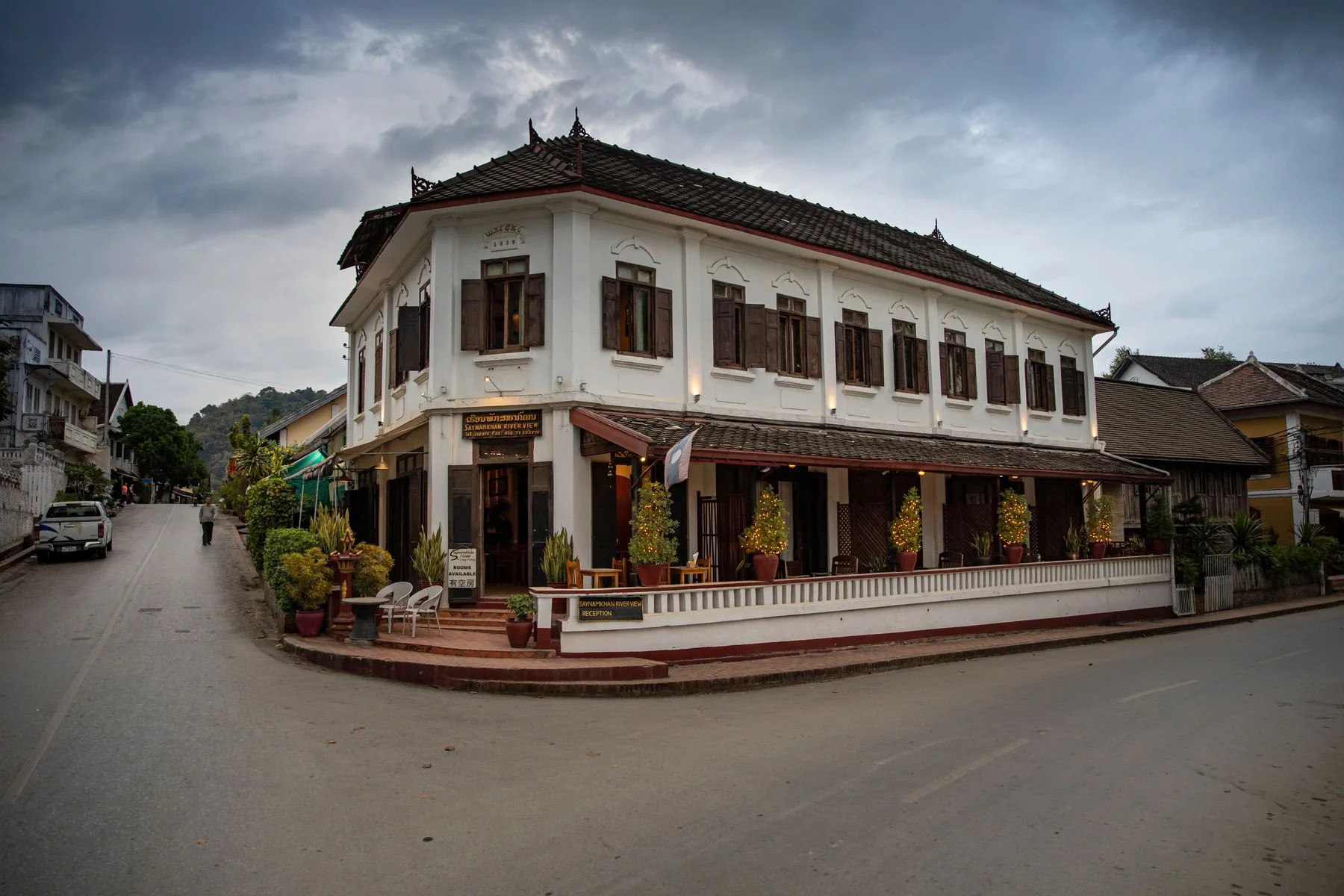
How accommodation works in Laos
Accommodation in Laos ranges from simple family guesthouses to heritage hotels, backpacker hostels, river resorts, eco-lodges and village homestays. The name of a property does not always tell you how polished it will be: a “guesthouse” can be beautifully designed, while a “resort” may offer little more than a group of bungalows.
Compare the exact room, recent reviews and included services rather than relying on the category alone. For neighbourhood-by-neighbourhood advice, use the individual guides to Vientiane, Vang Vieng, Luang Prabang and Pakse.
Types of accommodation
Guesthouses
Family-run guesthouses are found across the country, including small towns where international-style hotels are limited. They range from clean, basic rooms to restored wooden homes with thoughtful design.
The best guesthouses offer useful local knowledge, help with onward transport and a more personal stay than a standard hotel. Ask whether the room has a private bathroom, air conditioning, hot water and breakfast, because these are not automatic at the lowest prices.
Boutique and heritage hotels
Boutique properties usually offer stronger design, smaller room counts and more attentive service. Heritage hotels may occupy old townhouses or traditional timber buildings, especially in historic centres.
Old buildings have character but can also have thin walls, steep stairs or compact rooms. Look beyond staged photographs and check comments about maintenance, street noise and the exact room category.
Hostels
Hostels are concentrated in the main traveller hubs. Dorm beds are the cheapest option and can make it easy to meet other travellers, but the atmosphere varies from quiet and social to heavily party-focused.
Check bed curtains, lockers, bathroom ratios, quiet hours and whether air conditioning runs all day or only at night. Private hostel rooms are not always cheaper than a good local guesthouse.
Mid-range and international hotels
Mid-range hotels offer the most predictable combination of private bathrooms, daily housekeeping, reception and breakfast. Larger international hotels are mainly found in Vientiane and the most visited destinations.
They can be useful for late arrivals, work trips, accessible lifts, reliable card payment or a staffed front desk. Always check the location: a polished hotel far outside the centre may create daily transport costs.
Eco-lodges and homestays
Rural lodges and village stays bring you closer to the landscape and can direct more money into local communities. Rooms may be simple, meals may be shared and electricity or hot water can be limited.
Ask what is included, how local guides and hosts are paid, whether transport is arranged and what behaviour is expected in the community. A homestay should be approached as a hosted cultural experience, not a low-cost hotel.
Resorts and riverside stays
Resorts range from small riverside bungalow properties to full-service hotels with pools, restaurants and organised transfers. They work well when the property itself is part of the trip.
Check how isolated the resort is, whether restaurant prices fit your budget and how you will reach town. On islands and riverbanks, the final transfer may be by boat and may stop after dark.
What to check before booking
- Exact room type: the cheapest room may be in an older building or lack a window.
- Exact location: map pins can be inaccurate and stations often sit outside town.
- Noise: ask about bars, road traffic, temples and construction.
- Air conditioning: not every room category includes it.
- Hot water: especially in simple rural properties.
- Wi-Fi: ask about room coverage if you need to work.
- Access: check stairs, unpaved paths and boat transfers.
- Payment: smaller properties may prefer cash.
- Station transfer: confirm the real price and travel time.
Booking, payment and check-in
Book earlier for the peak dry-season months, major festivals and popular Luang Prabang dates. During quieter periods, keeping one or two nights flexible can make it easier to adjust your route.
Smaller properties may prefer cash even when an online platform accepted the reservation. Keep the booking confirmation offline and message the property if you will arrive late. For remote lodges, homestays and small river islands, contact the host before arrival because reception may not be staffed all day.
Cancellation conditions deserve attention when your route includes buses, boats or mountain roads. A flexible rate can be worth more than a small advance-payment discount.
Choosing the right type for your trip
- For local character: choose a well-reviewed family guesthouse or heritage stay.
- For a social trip: choose a hostel after checking its atmosphere and quiet hours.
- For predictable comfort: choose a staffed mid-range hotel.
- For nature: choose an eco-lodge or riverside property with transfers included.
- For a hosted cultural experience: choose a responsibly run homestay.
- For a rest day: choose a resort only if its location and facilities justify staying on site.
Once you know the accommodation style you want, open the relevant city guide for its detailed Where to stay section. Before confirming several non-refundable stays, read how to get around Laos and make sure the route is realistic.